

Risk Management
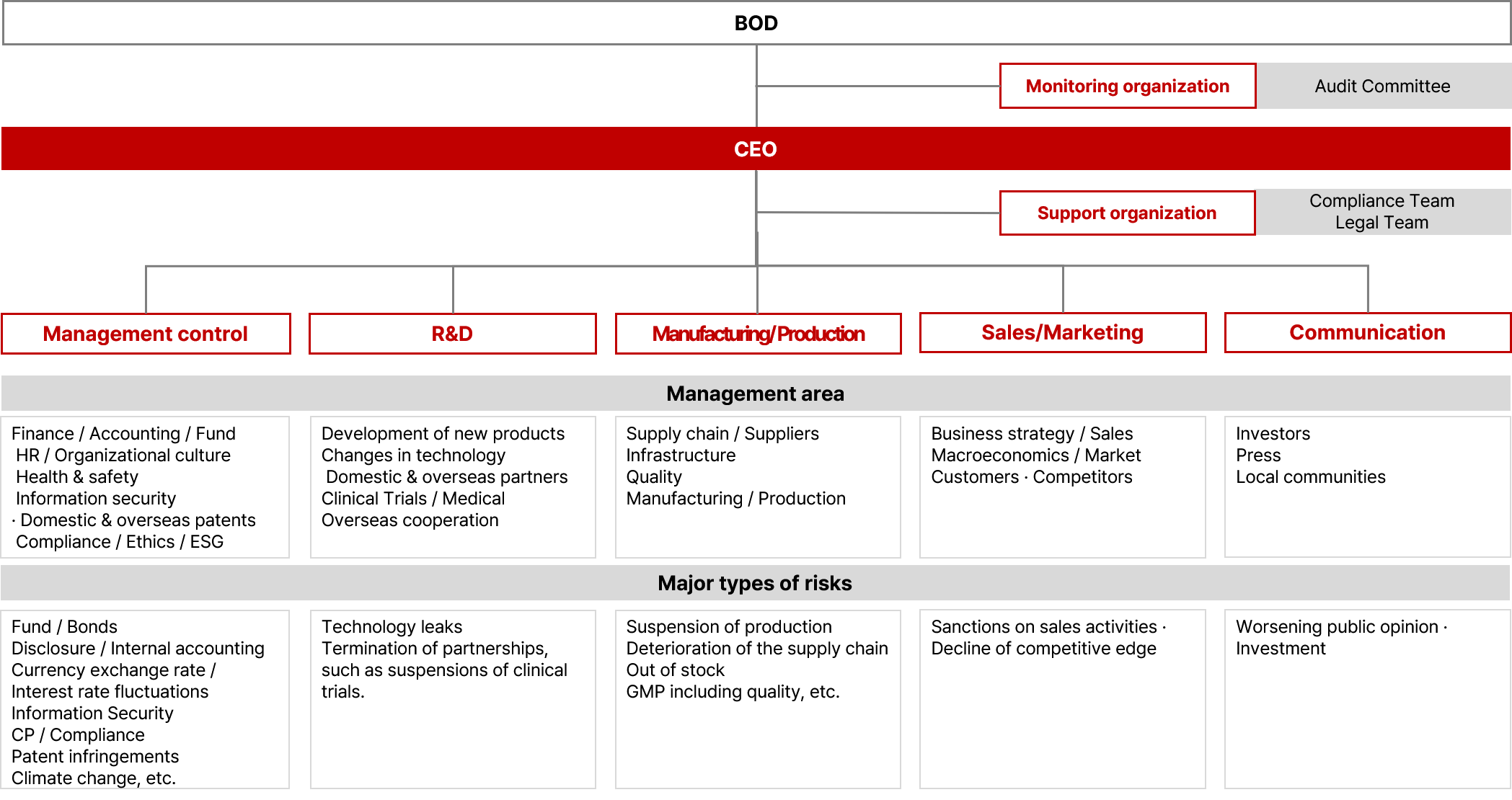
Hanmi Pharmaceutical operates an integrated risk management system that reflects the characteristics and strategies of its business to prevent and manage potential risks that may arise throughout the entire business process. Risks for each division are identified, assessed, and their response plans reviewed/implemented by dedicated organizations for each area. The monthly Executive Meeting comprehensively manages company-wide risks, including actual and potential risks that may arise across the entire business.
Risk Management System
Potential Risks
To prevent and manage potential risks that may arise throughout its business processes, Hanmi Pharmaceutical categorizes these risks into areas such as climate change, unfair trade, production stoppage, safety and health, information security, and quality, with each risk type monitored and responded to by a dedicated department. In particular, each classified risk is managed through a global-level risk management system by applying international standard management systems.
Category | Risk | Opportunity factors | Response Plan |
Climate | ㆍStrengthening domestic and international | ㆍMeeting stakeholder expectations through proactive | ㆍOperation of ISO 14001 |
Domestic & | ㆍUncertainty in domestic and international | ㆍOpportunity to expand export countries and share | ㆍPromotion of business portfolio diversification |
Unfair Trade | ㆍViolation of fair competition rules for pharmaceuticals | ㆍEnhancement of corporate value through | ㆍEstablishment of ISO 37001 |
Production | ㆍFacility damage and production disruption due to | ㆍDisaster prevention | ㆍEstablishment of ISO 22301 |
Information | ㆍOccurrence of various financial losses, such | ㆍMinimizing financial losses through the prevention of | ㆍOperating a dedicated information protection |
Tax Risk Management
Hanmi Pharmaceutical diligently adheres to national laws, files tax returns, and fulfills its tax obligations for transparent and legitimate tax practices. Furthermore, it promptly and transparently provides data when requested for investigation or information by tax authorities.
Management Principles | 1. Compliance with National Laws |
2. Prompt and Transparent Provision of Information to Tax Authorities | |
3. Prior Review and Analysis of Tax Risks Internally and Externally | |
4. Adherence to Arm's-Length Principle for Related-Party Transactions | |
5. Managing International Tax Risks according to OECD Transfer Pricing Guidelines |
Tax Risk Management Activities
Hanmi Pharmaceutical conducts prior internal and external tax risk reviews to prevent tax risks that may arise from business activities. It regularly seeks review and advice from external experts on significant tax issues that may arise during business operations. Particularly for domestic transactions, it maintains fair transaction prices in dealings with third parties and related parties in accordance with relevant laws, and for global business transactions, it prevents international tax risks based on expert advice and the OECD Transfer Pricing Guidelines. Internally, tax personnel are assigned to proactively manage tax risks through review and analysis of tax law amendments that occur annually.
Tax Risk Assessment
Hanmi Pharmaceutical makes its best efforts to fulfill its social responsibilities based on transparent and legitimate tax practices and internal and external tax risk management through external experts and internal tax personnel. It proactively reviews tax risks for important business matters such as transactions of goods and services, acquisition of shares, international transactions, pursuit of new businesses, and changes in transaction structures, and reflects the results of these reviews in final decision-making.
Accounts Receivable Risk Management
Hanmi Pharmaceutical manages accounts receivable risk for smooth fund operation through stable debt collection.
Accounts Receivable Risk Management Activities
Hanmi Pharmaceutical's accounts receivable management is carried out through business managers and the accounts receivable management department. Based on an 'accounts receivable management system' optimized for our business operations, we regularly check and manage same-day sales, revenue, adherence to client payment terms, client collateral management, and accounts receivable status. Furthermore, we make our best efforts to proactively respond to the risk of bad debt occurrence by cooperating with external credit rating agencies to frequently assess the management and business activities of our clients.
Risk Management through Global Standard Management Systems
Hanmi Pharmaceutical categorizes potential risks that may arise throughout its business operations into 6 major crisis response areas and 11 key risks, including environment, labor, fair trade, information security, disaster, and medical device quality. Each risk type is then assigned to a dedicated department for monitoring and response activities. By applying international standard management systems to address these classified risks, the company operates a global-level risk management system.
Hanmi Pharmaceutical's ISO (Global Standard Management Certification System) Certification Status
Key Risks | Certification | Business Site | Validity Period | Content |
Environment | ||||
Environmental | ISO 14001 | Paltan Smart Plant | 2023.09.29~2026.09.28 | - Establishment and application of control manuals/procedures/ |
Human Rights/Labor | ||||
Industrial Safety | ISO 45001 | Headquarters | 2024.10.29~2027.10.28 | - Expanded investment in safety and health |
Information Security | ||||
Internal Information | ISO 27001 | R&D Center | 2024.12.19~2027.12.18 | - First ISO 27001 certification in the domestic pharmaceutical industry |
Fair Trade and Compliance Management | ||||
Unfair Customer | ISO 37001 | Headquarters | 2024.11.29~2026.11.27 | - First introduced in the domestic pharmaceutical industry in 2017 |
ISO 37301 | Headquarters | 2024.11.29~2026.11.28 | - First ISO 37301 acquisition in 2024 | |
Disasters | ||||
Production | ISO 22301 | Headquarters | 2025.12.13~2028.12.12 | - Identify the impact on business operations when risks occur through |
Quality | ||||
Medical Device | ISO 13485 | Pyeongtaek Bioplant | 2026.01.21~2029.01.21 | - First acquired ISO 13485 in 2011, maintaining certification through |