

Pharmaceutical Product Safety Assurance
Ⅰ. Governance
Decision-making Structure
Hanmi Pharmaceutical enhances product quality by consistently producing all pharmaceuticals it manufactures and manages. To maintain a high level of GMP (Good Manufacturing Practice), we establish and operate a GMP Committee at each production facility, capable of guiding and supervising tasks related to GMP operations. In necessary production facilities, a Quality Risk Management Committee is convened and operated for the overall management of quality risk.
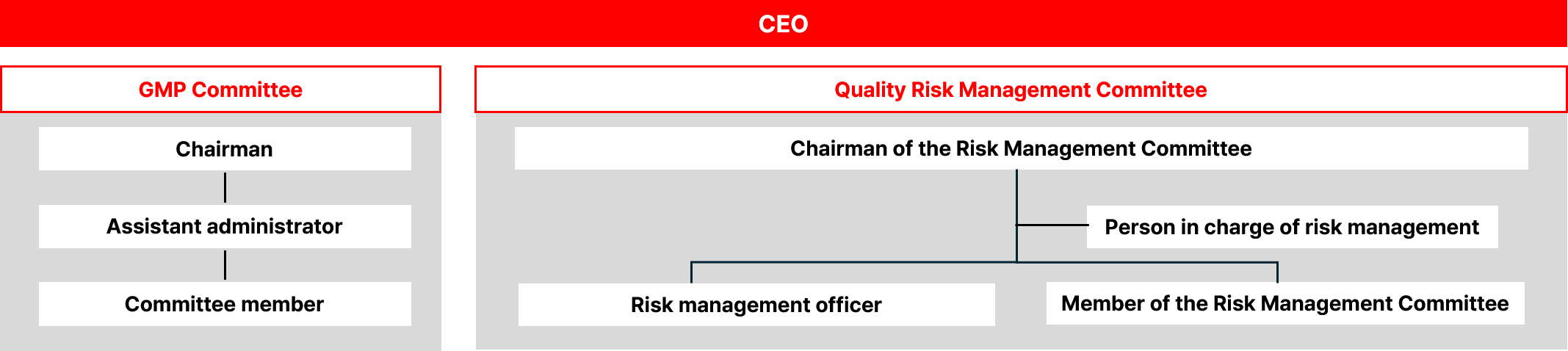
Pharmaceutical Safety Assurance Management Committee
Category | Frequency | Role |
GMP Committee | At least once a month or | ㆍGuide/supervise tasks related to GMP operations to maintain a high level of GMP |
Quality Risk Management Committee | Ongoing | •Operating procedures that enable effective and consistent risk-based decision-making |
Roles of Dedicated Organizations
Category | Roles/Authorities | |
CEO | •Overall supervision of pharmaceutical safety assurance | |
GMP Committee | Chairman | •Chair of the GMP Committee, overall management of operations |
Secretary | •Assists the Chairman, reports important matters to top management | |
Member | •Heads of respective departments, experts in each field, decides on various GMP-related matters | |
Quality | Risk Management Chairman | •Overall responsibility for risk management, reports to the head of the company |
Risk Management Coordinator | •Convenes the Risk Analysis Committee, compiles risk management data, responsible for the appropriateness of procedures | |
Risk Management Member | •Selects risk management tools, conducts analysis / initiates and evaluates mitigation of potential risks | |
Risk Management Officer | •Coordinates the convening of the Risk Analysis Committee, manages documents | |
Training for Maintaining Professional Expertise in Pharmaceutical Safety Assurance
Hanmi Pharmaceutical consistently attends all manufacturing manager training required by regulatory authorities, thereby continuously maintaining its professionalism and qualifications for ensuring pharmaceutical safety.
Category | Subject | Hours | Training Content |
Manufacturing | Manufacturing Site | 16 hours/2 years | ㆍManufacturing/Quality Control Standards, latest technologies by field, |
II. Strategy_Identification of Risks and Opportunities
Based on the analysis results from experts (IROs), Hanmi Pharmaceutical identifies key risks and opportunities that could significantly impact stakeholders and sustainability related to pharmaceutical safety assurance, and continuously strives to develop effective response strategies based on this identification.
RISK | |
|---|---|
Production stoppage, administrative measures due to quality risk occurrence | |
Nature of Impact | Actual Impact |
Affected Stakeholders | Customers |
Severity of Impact | Magnitude ■■■■□ / Scope ■■■■□ / Recoverability ■■■□□ |
Expected Financial Impact | Likelihood ■■□□□ / Magnitude ■■■■□ |
Impact on the Company | Drug safety is a core value and social responsibility of the pharmaceutical industry, and inadequate responses can lead |
Company's Response Approach | ㆍCompliance with international-level Good Manufacturing Practice (GMP) standards and establishment of |
OPPORTUNITY | |
|---|---|
Strengthening Drug Safety based on a Pharmacovigilance System | |
Nature of Impact | Actual Impact |
Affected Stakeholders | Employees |
Severity of Impact | Scale ■■■□□ / Scope ■■■■□ |
Expected Financial Impact | Likelihood ■■■□□ / Scale ■■■■□ |
Impact on the Company | Ensuring drug safety throughout the entire lifecycle of pharmaceuticals through detection, assessment, interpretation, |
Company's Response Approach | ㆍTransparent disclosure of recall and administrative disposition matters |
Ⅱ. Strategy_Risk and Opportunity Response Plan
Compliance with International-level Quality Management Standards (GMP)
5 Main Quality Policies for High Product Quality
To supply pharmaceuticals with guaranteed efficacy, safety, and quality to the market, Hanmi Pharmaceutical establishes and maintains a quality management system that meets the requirements of cGMP, laws, regulatory bodies, and ISO standards throughout the entire drug manufacturing process. Furthermore, based on know-how gained through numerous audits and collaborations with domestic and international regulatory bodies and partners over many years, our quality management system is capable of meeting not only domestic (MFDS) but also Global standard Quality system (US FDA six system / EMA) requirements. Based on production and distribution technologies that satisfy global standards and a high-quality system, we are doing our utmost based on five virtues to grow into an even higher global pharmaceutical company.
High Quality | We guarantee that the pharmaceuticals manufactured and supplied are produced and managed under a high-level quality system. |
Compliance | We operate systems and procedures in compliance with GMP regulations and guidelines distributed by international regulatory authorities. |
Integrity | We guarantee the accuracy and completeness of data generated throughout the entire process of drug manufacturing and management. |
Innovation | We encourage and support continuous innovation across all GMP areas. |
Partnership | We maintain amicable cooperative relationships with domestic and international partners to expand our business areas. |
Hanmi Pharmaceutical Quality System
Under the management goal of providing safe and reliable medicines to consumers, all finished pharmaceutical products developed, produced, stored, and manufactured at Hanmi Pharmaceutical are managed within a quality system from the stage of pharmaceutical development, including the receipt of related raw materials, testing, dispatch, manufacture of semi-finished/finished products, In Process Control (IPC), product testing, labeling and packaging, storage, shipment, and distribution. Even after distribution, continuous monitoring is conducted from the perspective of safety and efficacy, thereby strictly and thoroughly managing the entire life cycle of distributed pharmaceuticals.
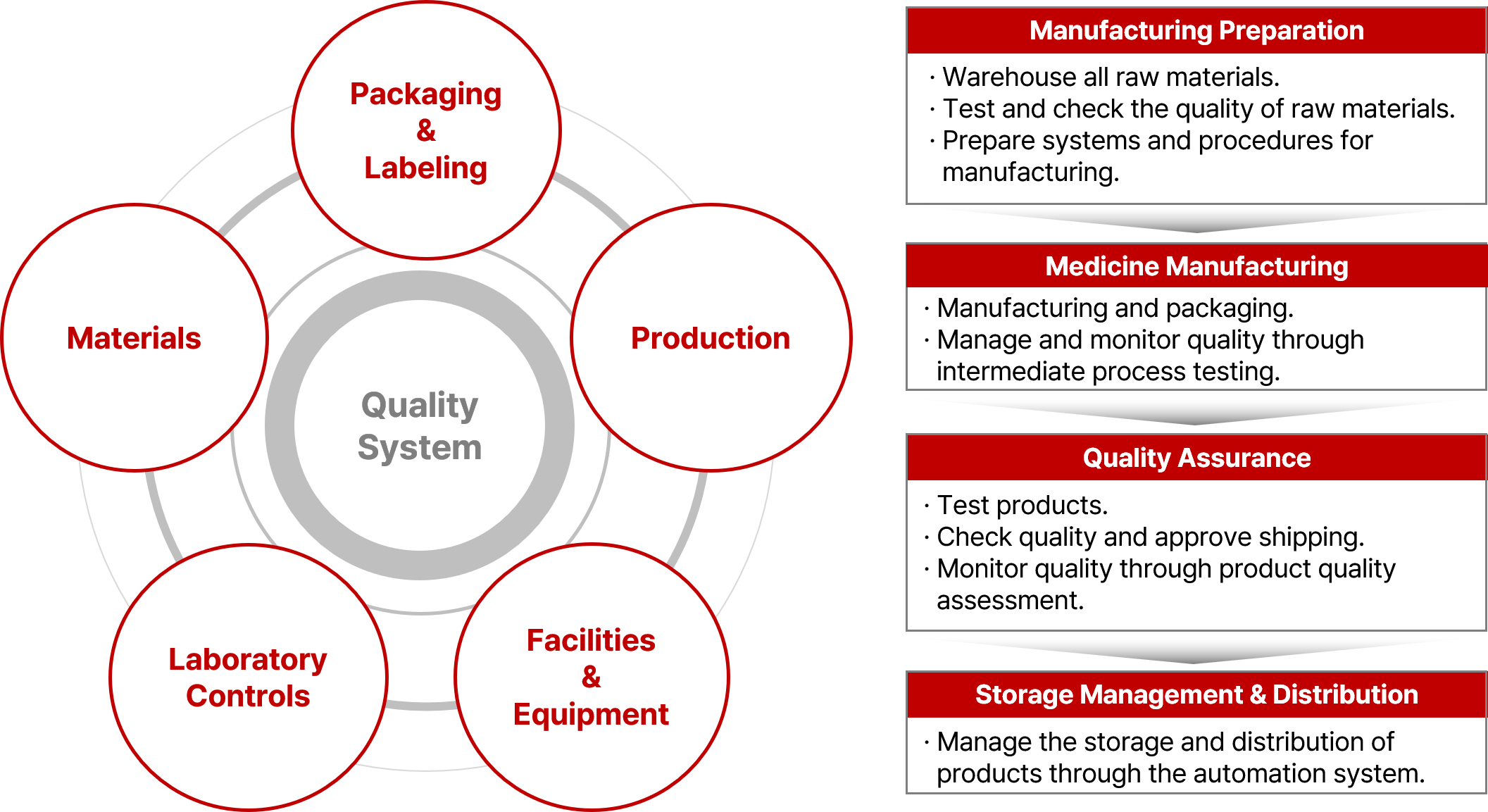
Performance and Development Plan of the Quality Management System
Hanmi Pharmaceutical's quality management system encompasses all elements of the quality system and management responsibilities, demanding the achievement, maintenance, and continuous improvement of pharmaceutical efficacy, safety, and quality control levels. Accordingly, Hanmi Pharmaceutical establishes quality objectives based on business goals, and the performance is regularly reported to management through committees. To continuously supply high-quality pharmaceuticals, management reviews and supports the necessity of facility investment, employee recruitment, software improvements, and the introduction of computerized systems, thereby striving to maintain the production and supply of high-quality pharmaceuticals. To more thoroughly ensure the efficient operation of the quality system and the Data Integrity of data generated throughout pharmaceutical development, manufacturing, and quality control, computerized systems such as ERP (Enterprise Resource Planning), EDMS (Electronic document management system), MES (Manufacturing Execution system), and LIMS (Laboratory Information Management System) have been introduced and are in use across various areas. Furthermore, by assigning Data Integrity specialists to each department, we ensure the integrity of data generated throughout pharmaceutical manufacturing, track related issues, and take timely actions on matters requiring improvement. Our company conducts regular risk assessments for each GMP department to continuously strengthen the level of data integrity, and based on these assessments, we are continuously evolving our quality management system.
Regulatory Authority and Partner Audit History

To date, Hanmi Pharmaceutical has certified the effectiveness and suitability of its operational quality management system through inspections by regulatory bodies such as MFDS (Korea), US FDA (United States), EMA (Europe), PMDA (Japan), and MITRF (Russia). By regularly undergoing audits from partners in various countries, we assure them that a reliable GMP system is in operation. In 2025, we underwent a total of 10 inspections from domestic and international regulatory/certification bodies and partners, including the US FDA and Korea's Ministry of Food and Drug Safety (MFDS), through which we confirmed that our manufacturing facilities and quality system are robustly maintained.
History of Major Regulatory Agency Inspections Over the Last 5 Years
No | Period | Country/Regulatory Authority | Content |
1 | 2021.10.18 | Korea / SGS | ㆍISO 13485 Surveillance Audit |
2 | 2022.04.11~14 | Russia / Ministry of Industry and Trade | ㆍRegular GMP Inspection |
3 | 2022.05.09~13 | Korea / Ministry of Food and Drug Safety (MFDS) | ㆍRegular GMP Inspection (Biopharmaceuticals) |
4 | 2022.06.27~07.05 | USA / USFDA(CDER) | ㆍDrug PLI Inspection: Rolvedon (Pre-License Inspection) |
5 | 2022.07.11~15 | Korea / Ministry of Food and Drug Safety (MFDS) | ㆍRegular GMP Inspection |
6 | 2022.10.17~20 | Europe / NSF Health Sciences Limited | ㆍQP Inspection: HM43239 20mg & 80mg Tab. |
7 | 2022.09.26~28 | Korea / SGS | ㆍISO 13485 Renewal Audit |
8 | 2023.04.11~14 | Korea / Ministry of Food and Drug Safety (MFDS) | ㆍCMO Suitability Assessment |
9 | 2023.11.09 | Korea / SGS | ㆍISO 13485 Surveillance Audit |
10 | 2024.07.25~08.02 | USA / USFDA | ㆍRegular Inspection of Pharmaceutical Manufacturing Site |
11 | 2024.08.19~22 | Europe / NSF | ㆍEU Qualified Person Regular Audit |
12 | 2024.09.10~12 | Korea / Ministry of Food and Drug Safety (MFDS) | ㆍPre-GMP Inspection (Pyeongtaek Solid Dosage Form) |
13 | 2024.11.11~12 | Korea / SGS | ㆍISO 13485 Post-Audit |
14 | 2025.02.17~21 | Korea / Ministry of Food and Drug Safety (MFDS) | ㆍRegular GMP Inspection and Pre-GMP Inspection (Pyeongtaek Bioplant) |
15 | 2025.02.17~21 | Korea / Ministry of Food and Drug Safety (MFDS) | ㆍRegular GMP Inspection (Pyeongtaek Solid Dosage Form) |
16 | 2025.04.14~17 | Korea / Ministry of Food and Drug Safety (MFDS) | ㆍRegular GMP Inspection |
17 | 2025.09.29~10.01 | Korea / SGS | ㆍISO 13485 Renewal Audit |
2025 Partner Audits Received Status
No | Period | Partner | Content |
1 | 2025.05.13~14 | Organon | ㆍPartner Regular Audit |
2 | 2025.06.09~11 | MSD | ㆍPartner Regular Audit |
3 | 2025.06.12~13 | GC Pharma | ㆍPartner Regular Audit |
4 | 2025.10.22~23 | Sanofi | ㆍPartner Regular Audit |
5 | 2025.11.27 | TEVA-Handok | ㆍPartner New Audit |
6 | 2025.12.09~11 | MSD | ㆍPartner Regular Audit |
Systematic Quality Assurance System
Establishment of Risk-based Quality Assurance System
Hanmi Pharmaceutical operates a quality assurance system by applying risk management procedures to all processes in the GMP area that require a risk management approach throughout the entire product lifecycle. By making effective and consistent decisions based on risk assessment results related to pharmaceutical quality, we prevent foreseeable risks and implement measures to minimize the extent of risks that must be accepted.
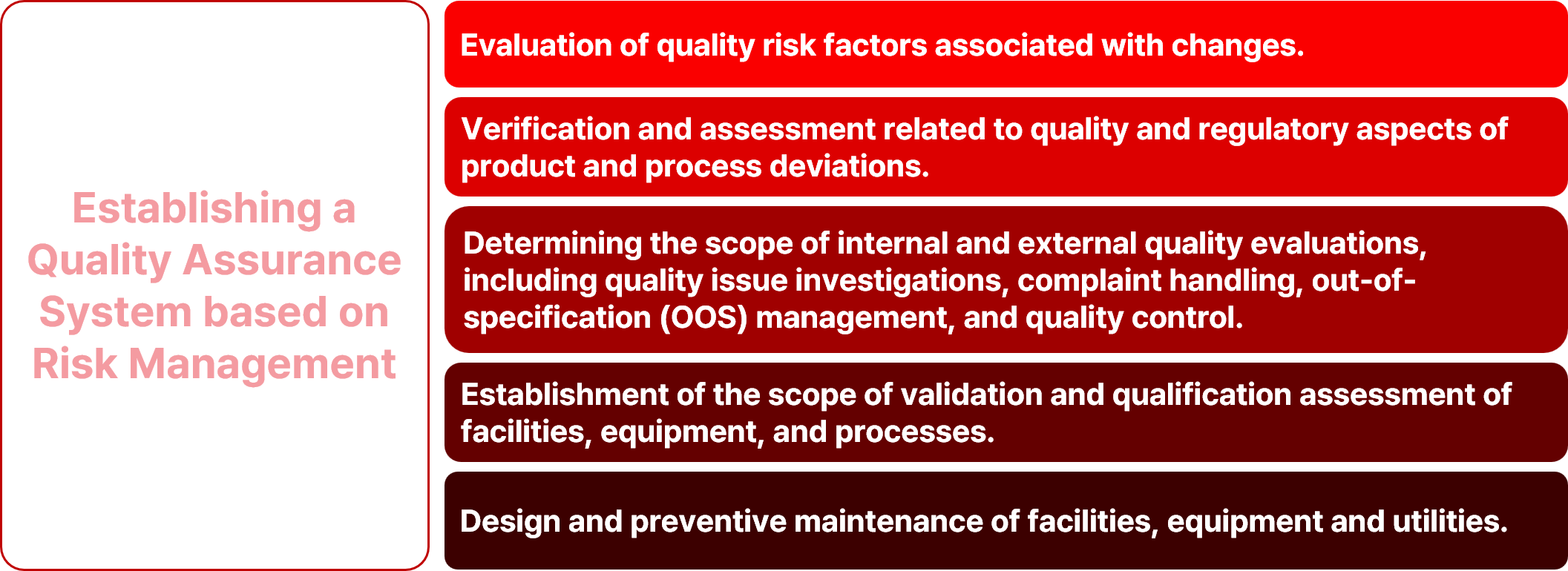
Education and Training
Hanmi Pharmaceutical manages GMP training through its electronic learning management system, LMS (Learning Management System). All employees working at business sites are assigned duties only after completing training appropriate for their respective roles, including on-the-job training. Regular basic GMP-related training is conducted to ensure that employees are adequately aware of the key concepts of the quality system and the importance of pharmaceutical quality control. Additionally, employees are supported to complete external training operated by pharmaceutical-related institutions, universities, the Ministry of Food and Drug Safety (MFDS), and overseas regulatory agencies based on their required topics, in addition to internal training. When necessary, secondary training is appropriately conducted by providing cascade training to required personnel.
Category | 2023 | 2024 | 2025 |
Total Number of GMP Training Sessions | 6,777 | 7,482 | 16,418 |
Inspections for Pharmaceutical Safety
Hanmi Pharmaceutical voluntarily inspects the entire process and results of product manufacturing and quality control, as well as the integrity of all data generated during these processes, through its Quality Assurance department. We strive to improve any deficiencies ourselves to supply excellent pharmaceuticals to patients.
Self-Inspection | Conduct inspections of all departments related to pharmaceutical manufacturing/quality control activities at least once a year, and implement improvements through CAPA if factors posing risks to manufacturing/quality control are identified. |
Quality Department | A procedure performed separately from self-inspection, where the Quality Department strengthens inspection procedures for four areas: manufacturing, quality, manufacturing infrastructure, and support centers, thereby preventing potential issues in advance and enhancing the management status across all divisions. |
Data Review | Periodically review and approve data (including audit trails) generated during manufacturing, manufacturing support, and testing by the relevant departments and the Quality Department to ensure compliance with related procedures and data integrity. |
Genotoxic Impurity Management
Hanmi Pharmaceutical has established and operates procedures that enable quick and immediate responses upon the issuance of safety information and official directives regarding genotoxic impurities from overseas authorities and the MFDS. We identify affected products based on safety information, verify all batches currently on the market, establish analytical methods capable of detecting these impurities, and determine the impurity levels within distributed batches as quickly as possible. For previously produced batches exceeding the specified limits, sales suspension and recall measures are taken in accordance with MFDS review results. For future production batches, various methods to reduce the genotoxic impurities are reviewed, and quality tests for these impurities are performed upon batch release, thereby striving to ensure that only safe pharmaceuticals are supplied to patients.
Advanced Quality Control System
Hanmi Pharmaceutical's Quality Control Group collects samples of raw materials, intermediates, and final products used in pharmaceutical manufacturing, conducts product characteristic analyses required by authorities, and performs evaluations across all development stages, including release testing and stability testing for pharmaceuticals manufactured according to verified analytical methods and approved specifications, to ensure the safety, stability, and overall quality of manufactured and distributed raw materials/finished pharmaceuticals.
Quality Control Testing
Hanmi Pharmaceutical ensures that the quality of all distributed pharmaceuticals is maintained throughout their product lifecycle by performing raw material testing, in-process controls (IPC), drug product release testing, and stability testing related to the pharmaceuticals manufactured. Furthermore, in accordance with ICH Q2(R1) guidelines, method development and method transfer for developed methods are possible, and method verification as required by domestic and international regulatory agencies is also performed. A system is established to manage the release and distribution of only finished pharmaceutical products whose quality has been confirmed to meet standards through release testing, and employees performing quality control duties are regularly qualified through job-specific training and evaluations.
Physicochemical Testing | Appearance, moisture, pH, osmolarity check |
Microbiological test | Sterility test, microbial limit test, microbial identification, endotoxin, insoluble particulate matter |
Instrumental analysis | HPLC, UPLC, GC, GC-MS, FT-IR, UV, TOC |
Stability program
Hanmi Pharmaceutical guarantees that the quality of pharmaceuticals manufactured by the company remains stable throughout the product lifecycle. Generally, stability rooms/chambers for long-term and accelerated conditions are operated according to product storage conditions, and facilities capable of performing stability tests under other special requirements are prepared to collect physical/mechanical stability data for pharmaceuticals. The stability data collected is monitored in real-time, and in the event of significant changes or non-conformities in drug quality, immediate impact assessments and reports to regulatory authorities are made according to relevant procedures to ensure necessary measures are taken.
Environmental and clean utility monitoring
Hanmi Pharmaceutical designs and manages all areas where pharmaceuticals are manufactured, packaged, and stored to be suitable for operation, maintenance, and cleaning. Walls are managed with clean panels for easy cleaning and maintenance, and floor surfaces are epoxy-coated to prevent contamination in the manufacturing environment and facilitate cleaning. Furthermore, environmental monitoring is conducted by categorizing cleanliness levels for each area, and process water, water for injection, and compressed air used in manufacturing are periodically sampled and subjected to quality tests. During environmental monitoring, tests are performed for airborne viable particles (settle plates), airborne non-viable particles (active air sampling), surface microbial counts, and particulate matter for each cleanliness grade. For water monitoring, tests for appearance, total organic carbon, conductivity, nitrate, pH, and endotoxin are conducted. All air compressors are oil-free type and supplied after passing through a 0.2μm filter.
Monitoring system within the lifecycle of shipped pharmaceuticals
Drug theft and counterfeiting monitoring system
Hanmi Pharmaceutical has established and operates a system for preventing counterfeit drugs and ensuring safety management from the manufacturing to the final distribution stage of finished pharmaceuticals, utilizing an ERP (Enterprise Resource Planning) system and unique identification devices like RFID (Radio-Frequency Identification) Tags. When a headquarters sales representative inputs order information received from a client company into the ERP system, this information is automatically transmitted to the delivery team via the system, and subsequently, shipment information for the ordered products can be confirmed in real-time through the system. All finished pharmaceuticals manufactured and shipped by Hanmi Pharmaceutical support the use of serialization and tracking technologies using RFID Tags, thereby strengthening supply chain security and establishing and managing a system compliant with distribution management policies in relevant export countries, including South Korea. Detailed information (manufacturing date, batch number, shipment date, customer information, etc.) for all finished pharmaceuticals dispatched and distributed is recorded in the internal system, enabling tracing and prompt action in the event of a report regarding counterfeit drugs. Furthermore, upon receipt of a consumer complaint, a swift investigation is conducted according to internal quality assurance procedures to assess the potential impact of the complaint on product quality, after which improvement measures are formulated to ensure appropriate actions are taken in a timely manner.
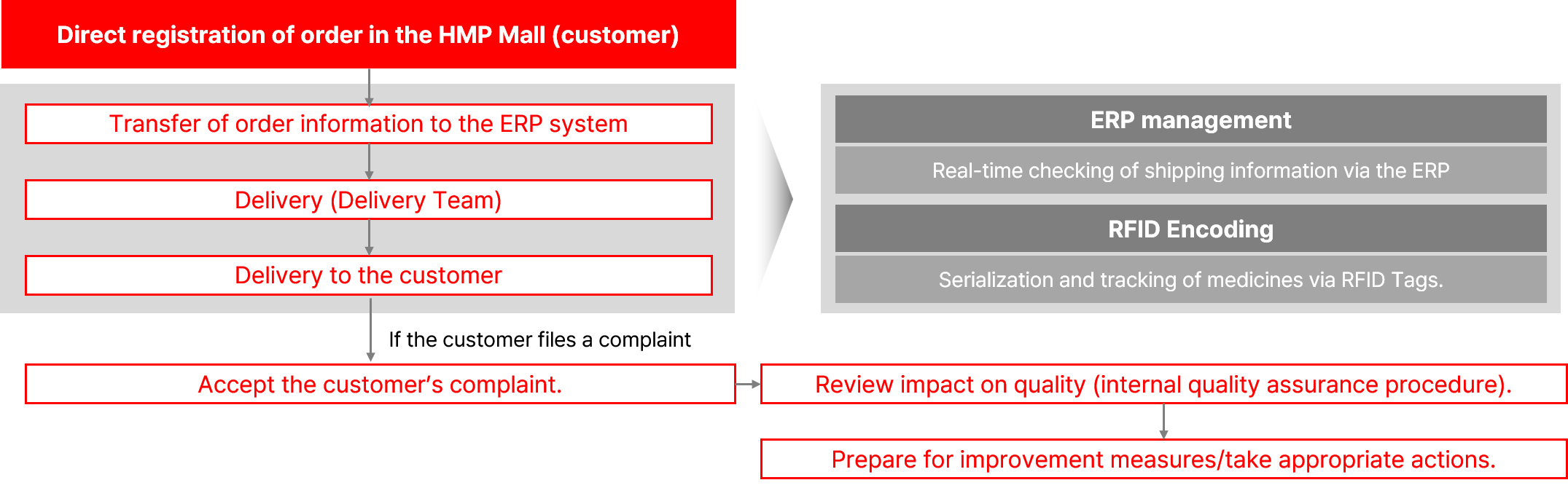
Pharmacovigilance system
Pharmacovigilance refers to the scientific activities concerning the detection, assessment, understanding, and prevention of adverse drug reactions or safety-related problems of pharmaceuticals. Pharmacovigilance is an activity conducted throughout the entire lifecycle of a drug, from the collection of drug safety information to risk management. In Korea, continuous supplementation and development of the pharmacovigilance system are being made by introducing and strengthening policies such as the drug re-evaluation system, the voluntary adverse event reporting system, the risk management plan system, recommendations for appropriate drug use, and the drug adverse reaction relief system. Hanmi Pharmaceutical, aiming to contribute to enhancing drug safety, has established and operates its own pharmacovigilance system, collecting and analyzing safety information for its own pharmaceutical products through various channels.
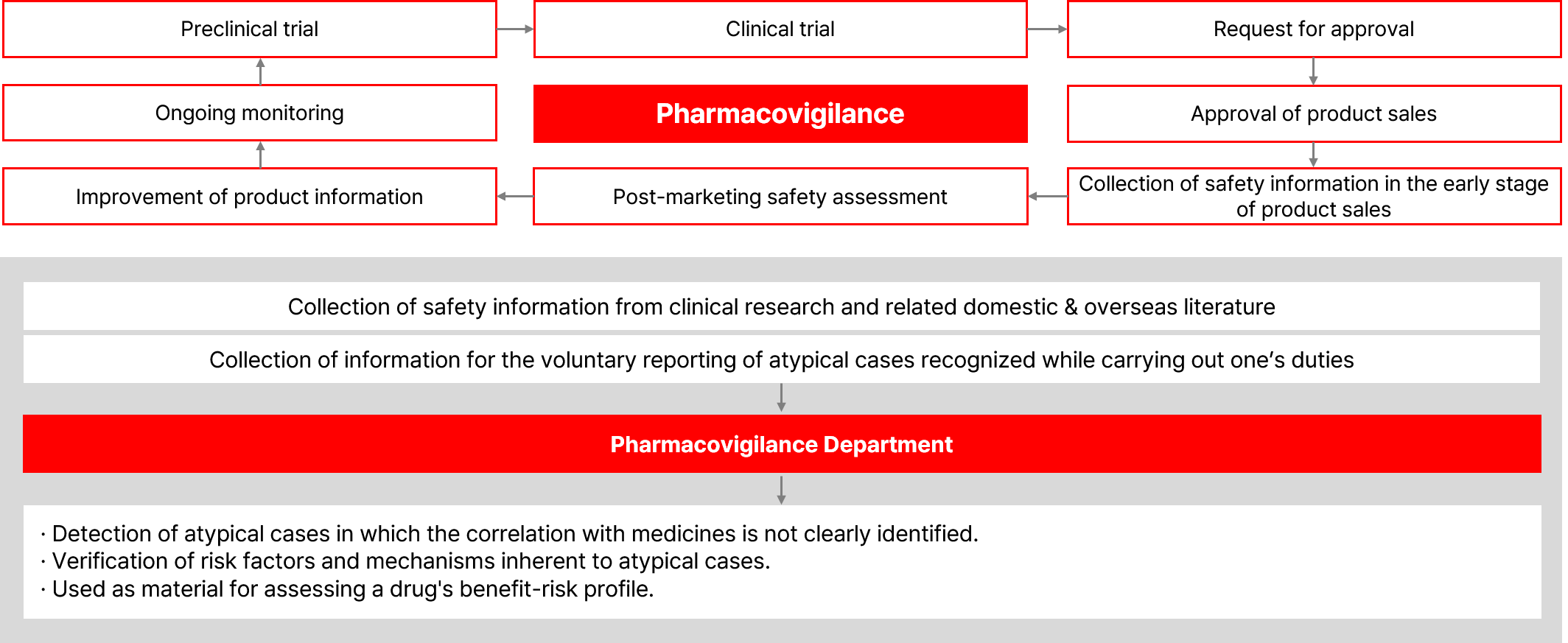
Pharmacovigilance training
Hanmi Pharmaceutical conducts its own regular pharmacovigilance training for all employees annually. This training emphasizes the necessity and importance of pharmacovigilance while providing guidelines for all employees to timely report information about adverse events they may encounter in their work to the pharmacovigilance department. This strengthens the company-wide pharmacovigilance system and contributes to improving Hanmi Pharmaceutical's drug safety management.
Category | Unit | 2022 | 2023 | 2024 | 2025 |
No. of employees | persons | 2,350 | 2,315 | 2,476 | 2,553 |
Training completion rate | % | 99.4 | 99.7 | 91.1 | 91.3 |
Customer health and safety
As all products manufactured by Hanmi Pharmaceutical are directly linked to health and life, we continuously strengthen and monitor our capabilities to ensure product safety. Hanmi Pharmaceutical transparently discloses publicly available product information to ensure that customers can safely take all its products, and considers customer safety and health aspects from the product development stage. Furthermore, customer feedback related to products is collected and managed in accordance with the regulations of the Ministry of Food and Drug Safety (MFDS).
Status of Pharmaceutical Product Recalls | Criteria: Dec. 31, 2025 | |||||
Category | 2023 | 2024 | 2025 | |||
|---|---|---|---|---|---|---|
Cases | Recalled Volume (ton) | Cases | Recalled Volume (ton) | Cases | Recalled Volume (ton) | |
Total | 3 | 3.97 | 1 | 1.07 | 6 | 6.41 |
Class Ⅰ | 0 | 0 | 0 | 0 | 0 | 0 |
Class ⅠⅠ | 2 | 2.77 | 1 | 1.07 | 61) | 6.41 |
Class ⅠⅠⅠ | 1 | 1.20 | 0 | 0 | 0 | 0 |
Status of Administrative Dispositions in 2025
Product | Content | Disposition |
|---|---|---|
Abiteron Duo Tab. 500/2.5mg | Manufactured differently from approved specifications (direct container material) | Administrative fine of KRW 1,800,000 imposed |
Group Integrated Call Center
Hanmi Pharmaceutical established its Group Integrated Call Center in 2014 and has been dedicated to listening to customers' voices. By managing collected issues and based on frequently asked questions about product usage, the company is actively working to eliminate factors causing customer inconvenience. This initiative is part of Hanmi Pharmaceutical's commitment to customer satisfaction management, aiming to enhance customer convenience and reach out to customers.
Category | Unit | 2023 | 2024 | 2025 |
Total No. of Customer Interactions | Cases | 66,890 | 62,906 | 63,689 |
Hanmi Pharmaceutical | 12,920 | 10,635 | 10,726 | |
Hanmi Science | 8,790 | 6,716 | 5,887 | |
Online Pharm | 45,180 | 45,555 | 47,076 |
Hanmi Pharmaceutical's Major Customer Feedback Received and Actions Taken in 2025
Product | Customer Feedback | Actions Taken |
|---|---|---|
TenTen Chewable Tab. | Empty packaging | Empty packaging occasionally occurs during packaging material roll changes in the packaging process. The empty packaging removal device fan was replaced and installed to ensure smooth removal of empty packaged products. |
Hanmi Tams Capsule | Dent/crushed capsule | To prevent human error that may occur during the defective product disposal process, the defective product discharge direction was indicated, and the bottom of the good product discharge section of the capsule weight sorter was reinforced. |
Coza XQ Tablet | RFID lookup unavailable | A cover was installed on the defective product sorting bin of the RFID process inspection machine to physically block the possibility of human error. |
Amosartan Tablet 5/50mg | Similar design | Design change implemented to prevent the possibility of medication errors due to similar ingredient products and similar packaging designs. |
III. Risk Management
Hanmi Pharmaceutical effectively manages enterprise-wide risks and maximizes potential opportunities to foster sustainable growth by integrating its risk and opportunity management process, related to pharmaceutical safety assurance, with the Enterprise Risk Management (ERM) system.
Risk and Opportunity Monitoring | Frequency | Subjects | Method | Oversight |
|---|---|---|---|---|
Regulatory | Upon | All domestically | ㆍMaintain high GMP standards at all times through a voluntary regular inspection system, | QA |
Risk Assessment | As needed | When evaluation | ㆍRisk assessment using risk management tools presented in the quality risk management | QA |
Pharmacovigilance | On an | Entire lifecycle of | ㆍ Monitoring and analyzing domestic and international academic literature, regulations, and | PV |
Ⅳ. Indicators and Targets
Key Indicators | 2025 Targets | 2025 Performance | Attainment | 2026 Targets | Mid-to-Long-Term Plan (2030) |
|---|---|---|---|---|---|
Global level | ㆍZero Critical findings per case | Regulatory Audits | Achieved | · Preparation for EU GMP | · Maintain a continuous audit readiness |
Quality System | ㆍSelection of over 30 quality in | Operated continuously at least once per | Achieved | · Establishment of a real-time | · Through quality indicator monitoring, |