

Responsible Supply Chain Management
Ⅰ. Governance
Decision-making Structure
Hanmi Pharmaceutical has established and operates four fair trade principles and a procurement code of ethics to ensure fair and ethical transactions. In particular, we are striving for responsible supply chain management through the establishment of supply chain management regulations and the formulation of green purchasing policies. Since 2023, Hanmi Pharmaceutical has been operating an ESG due diligence system for its supply chain, identifying and assessing negative impacts on human rights, the environment, and other areas. The targets for ESG due diligence are Hanmi Pharmaceutical's activity-chain-based partners, for whom negative impacts on human rights, the environment, etc., are identified, and regular inspections and monitoring are conducted. To achieve this, a Sustainable Supply Chain Due Diligence TF has been formed, with collaboration between the Procurement Team, Quality Assurance Group, and the dedicated ESG department. Furthermore, HSRM is a supply chain management platform independently developed by Hanmi Pharmaceutical, serving as a communication channel between Hanmi Pharmaceutical and its partners. HSRM includes not only partner announcements but also a partner communication channel, bidding system operation, and export/import management functions, facilitating close communication with partners. Hanmi Pharmaceutical plans to address this as a material issue for sustainable management in the pharmaceutical industry by reviewing partner supply chain ESG risk management plans and performance and expanding relevant training through the ESG Committee, which will be established under the Board of Directors within 2026.
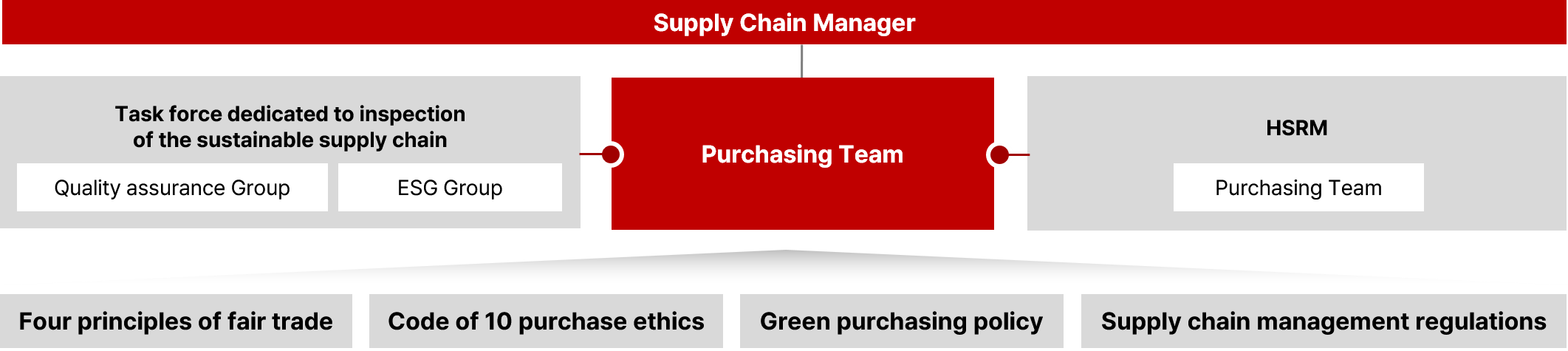
Roles and Responsibilities
Category | Roles and Responsibilities |
Supply Chain Manager | ㆍOverall responsibility for responsible supply chain management |
Purchasing Team | ㆍEstablishment of partner registration criteria |
Quality Assurance Group | ㆍDue diligence and evaluation of partners through quality checklist items (quality/GMP inspection) |
ESG Group | ㆍEstablishment of supply chain ESG strategy |
II. Strategy_Identification of Risks and Opportunities
Based on the results of the IRO analysis, Hanmi Pharmaceutical identifies key risks and opportunities that may significantly impact stakeholders and sustainability related to responsible supply chain management, and continuously strives to develop effective response measures based on these findings.
RISK | |
|---|---|
Demand from global customers to cease transactions in case of partner's environmental/human rights risks | |
Nature of Impact | Potential Impact |
Affected Stakeholders | Shareholders and investors, suppliers |
Severity of Impact | Scale ■■■□□ / Scope ■■■■□ / Recoverability ■■■□□ |
Expected Financial Impact | Likelihood ■■□□□ / Scale ■■■□□ |
Impact on the Company | ㆍTermination of global client transactions if supplier ESG due diligence is not conducted |
Company's Response Approach | ㆍEstablishment of a sustainable supply chain |
OPPORTUNITY | |
|---|---|
Maintaining transparent and fair relationships with suppliers | |
Nature of Impact | Actual Impact |
Affected Stakeholders | Shareholders and Investors, Customers |
Severity of Impact | Scale ■■■□□ / Scope ■■■□□ |
Expected Financial Impact | Likelihood ■■■□□ / Severity ■■■□□ |
Company's Response Approach | ㆍReorganization of the supply chain centered on suppliers with ESG risk management capabilities |
Ⅱ. Strategy_Risk and Opportunity Response Plan
Establishing a sustainable supply chain
Supply Chain Management Principles
To ensure fair supply chain management by preventing improper conduct, Hanmi Pharmaceutical has established and shared its Four Major Fair Trade Principles and Procurement Code of Ethics with its suppliers. Hanmi Pharmaceutical manages its suppliers in accordance with its Supplier Code of Conduct and Four Major Fair Trade Principles.
Hanmi Pharmaceutical's 4 Major Fair Trade Principles
Signing appropriate contracts for win-win cooperation | Fair selection & operation of suppliers |
Issue & file appropriate documentation | Prevent unfair trade by operating an internal review committee |
Ten Principles of Procurement Ethics
1 | No consideration other than the company's interests should be made in transactions with suppliers. |
2 | No collusive acts that could influence decision-making should be committed in any procurement activities with suppliers. |
3 | The selection and registration of business partners shall be carried out in a reasonable manner, based on objective and fair evaluation criteria. |
4 | Transactions based on personal connections such as regional or academic ties are excluded, and fair competition is prioritized. |
5 | Do not accept any form of entertainment or private gifts from business partners. |
6 | Do not engage in any form of unfair conduct using superior authority or status. |
7 | Never disclose the company's key information. |
8 | Do not engage in fictitious or false reporting in all purchasing activities, and always adhere to transparent principles. |
9 | Remind that any company found to be providing entertainment or personal gifts to our employees will be immediately suspended from transactions. |
10 | If the above contents are violated, accept any disciplinary action from the company. |
Hanmi Pharmaceutical Supply Chain Management Status
As a company that produces life-saving pharmaceuticals, Hanmi Pharmaceutical dedicates meticulous effort to discovering and selecting suppliers that meet stringent standards to provide quality medicines. Hanmi Pharmaceutical manages all existing and new suppliers separately each year. Furthermore, to provide consumers with quality-assured excellent medicines, we operate a Supply Chain Management Portal (HSRM) aimed at managing and evaluating all suppliers providing raw materials, semi-finished products, finished products, or services.
Company | Supplier Classification | Unit | 2023 | 2024 | 2025 |
|---|---|---|---|---|---|
Hanmi Pharmaceutical | Total Suppliers | Companies | 1,040 | 1,149 | 1,140 |
New Suppliers | Companies | 124 | 67 | 333 | |
Existing Suppliers | Companies | 916 | 1,082 | 807 | |
Direct partners(significant) | Companies | 286 | 343 | 276 | |
Direct partners(Other) | Companies | 754 | 739 | 864 | |
Total Purchase Amount | KRW 100 million | 2,255 | 2,166 | 2,449 | |
Beijing Hanmi Pharmaceutical | Total Suppliers | Companies | 168 | 169 | 184 |
New Suppliers | Companies | 22 | 12 | 22 | |
Total Purchase Amount | thousand CNY | 485,675 | 428,801 | 452,857 | |
Hanmi Fine Chemical | Total Suppliers | Companies | 2,070 | 2,161 | 2,252 |
New Suppliers | Companies | 87 | 91 | 91 | |
Total Purchase Amount | KRW 100 million | 743 | 615 | 368 |
Responsible Supply Chain Management
Hanmi Pharmaceutical inspects suppliers' ESG performance to identify and improve potential ESG risks within the supply chain. We have established and distributed the Hanmi Pharmaceutical Supplier Code of Conduct, referring to the global pharmaceutical supply chain initiative PSCI (Pharmaceutical Supply Chain Initiative) and K-ESG guidelines. Notably, in 2025, we conducted level assessment through an online supply chain due diligence platform, and on-site due diligence by a third party, namely in-depth assessment to check the suppliers' ESG status. Hanmi Pharmaceutical annually updates assessment items by referencing domestic and international supply chain ESG guidelines and current laws, and plans to continuously strengthen supply chain management through evaluation, inspection, and improvement.

2025 Supply Chain ESG Assessment Results
Hanmi Pharmaceutical identifies key raw material suppliers among its entire supply chain partners, considering business impact and the number of available suppliers for highly business-relevant partners such as raw materials and packaging materials. The 2025 supply chain ESG assessment was conducted through a level assessment (online self-diagnosis) and an in-depth assessment (on-site audit by a third party). For the assessment, an RTO for each area (Environment, Social, Governance, Information Disclosure)1) or lower was identified as a supplier requiring improvement. A total of 109 companies participated in the level assessment, with 82 of them identified as needing improvement, showing particular vulnerabilities in the environmental and information disclosure sectors. Furthermore, among the companies that underwent the level assessment, 36 key suppliers were selected for an in-depth assessment, and of these, 20 companies were identified as needing improvement, showing vulnerabilities in the safety and health sector.
Hanmi Pharmaceutical plans to identify areas requiring management and support for suppliers identified as needing improvement and monitor the progress of their risk improvement implementation. Additionally, the company plans to revise its 2026 supply chain ESG due diligence regulations and SOPs to establish a global-level supply chain ESG due diligence system.
1) RTO : Risk Trade-Off / Certain Level
<Level Assessment Results>
Category | Content |
Assessment Method | Online Platform Self-Diagnosis |
Assessment Scope | 109 direct suppliers of Hanmi Pharmaceutical |
Assessment Areas | Sufficiency and transparency of information in Environment/Social/Governance/Information Disclosure sectors |
Grading System | 5 (HIGHEST, HIGH, MEDIUM, LOW, LOWEST) |
Identification of Companies Requiring Improvement | Companies graded RTO or lower in each area |
Results | HIGHEST | HIGH | MEDIUM | LOW | LOWEST | Total |
By Grade | 27 | 27 | 25 | 25 | 5 | 109 |
Companies Requiring Improvement | - | 27 | 25 | 25 | 5 | 82 |
<In-Depth Assessment Results>
Category | Content |
Assessment Method | Third-Party Assessment (On-site Audit) |
Assessment Scope | Suppliers identified as needing improvement after the level assessment, who are expected to continue transactions and supply key materials |
Assessment Areas | Environment / Social / Governance |
Grading System | Assignment of A/B/C/D/E grades |
Identify companies requiring improvement | Companies with RTO-below ratings in each area |
Results | A | B | C | D | E | Total |
By Grade | - | 11 | 15 | 10 | - | 36 |
Companies Requiring Improvement | - | - | 10 | 10 | - | 20 |
Strengthening supply chain win-win cooperation system
Hanmi Pharmaceutical practices co-growth through various supplier support policies. We not only provide diverse educational support, such as training for the ESG advancement of our suppliers, but also operate systems like improved payment terms, volume assurance, long-term contracts, priority contracts for new products, and a supplier proposal system. Furthermore, in 2025, for effective and practical co-growth, we enhanced security risks and improved supplier convenience by upgrading 'e-Sarangbang', a multilateral communication channel among relevant departments, buyers, and suppliers. We also introduced and operate a third-party anonymous reporting channel (K-Whistle) where grievances such as power abuse, harassment, or sexual harassment against suppliers can be reported. Hanmi Pharmaceutical plans to undertake various improvement activities in the future to strengthen the win-win cooperation system with its suppliers.
Operating Hanmi Pharmaceutical-Supplier Communication Channels
HSRM Site | We streamline the product and service supply process through the Supplier Relationship Management (HSRM) system. |
e-Sarangbang | Through the operation of e-Sarangbang, a multilateral communication channel for stakeholders (relevant departments), buyers, and suppliers, we aim for fair and efficient business processes. |
Anonymous Reporting | Hanmi Pharmaceutical has introduced and operates a third-party anonymous reporting channel (K-Whistle) where grievances such as power abuse, harassment, or sexual harassment against suppliers can be reported. |
Supplier Mentorship | Hanmi Pharmaceutical operates a supplier mentorship program to practice co-growth with its suppliers. |
2025 Supplier Support Status
Category | Content | |
Education Support Program | Ethical Management | HSRM announcements and educational materials distributed regularly |
GMP Training | GMP Audit Support and Offline Training | |
ESG Education | ESG supply chain due diligence online training and on-site training during due diligence | |
Improvement of payment terms | 100% cash payment | |
Securing volume | Provision of advance payments for raw material imbalanced items to secure safety stock | |
Long-term contracts | Automatic annual contract renewal for excellent suppliers | |
Priority contracts for new products | Conclusion of priority supply contracts for new products | |
Supplier suggestion system | Review of joint projects upon supplier business collaboration proposals | |
Welfare services | Provision of Hanmi Pharmaceutical employee welfare mall services | |
III. Risk Management
Hanmi Pharmaceutical integrates risk and opportunity management processes related to responsible supply chain management with its Enterprise Risk Management (ERM) system, thereby effectively managing company-wide risks, maximizing potential opportunities, and promoting sustainable growth.
Risk and Opportunity Monitoring | Frequency | Subjects | Method | Oversight |
|---|---|---|---|---|
Raw/subsidiary material quality inspection | Ongoing | Raw/subsidiary | ㆍTo ensure excellent pharmaceutical production/management, supplier due diligence and | Quality |
Ad-hoc ESG | Once | Key suppliers | ㆍEvaluation by ESG domain (Environment, Social, Governance, Disclosure) | ESG Group |
Qualified | On an | Facility construction and maintenance contractors within business sites | ㆍAssessment of essential safety and health items such as industrial accident rate and risk | ESG Group |
Business Partner CP | Once | Exceeding a certain | ㆍEvaluation conducted through fair trade-related indicators | Compliance |
Ⅳ. Indicators and Targets
Key Indicators | 2025 Targets | 2025 Performance | Attainment | 2026 Targets | Mid-to-Long-Term Plan (2030) |
|---|---|---|---|---|---|
Supply chain | Introduction of an online platform for | ㆍImplementation and | Achieved | ㆍSupply chain due diligence | ㆍESGsupply chain due diligence |
Expansion of ESG supply chain | ㆍLevel assessment of | Achieved | ㆍMonitoring of companies | ㆍESG supply chain due diligence | |
Supply chain | Supplier mentorship conducted more | ㆍNot implemented | Unachieved | ㆍImplementation of supplier | ㆍConducting supplier mentorship |